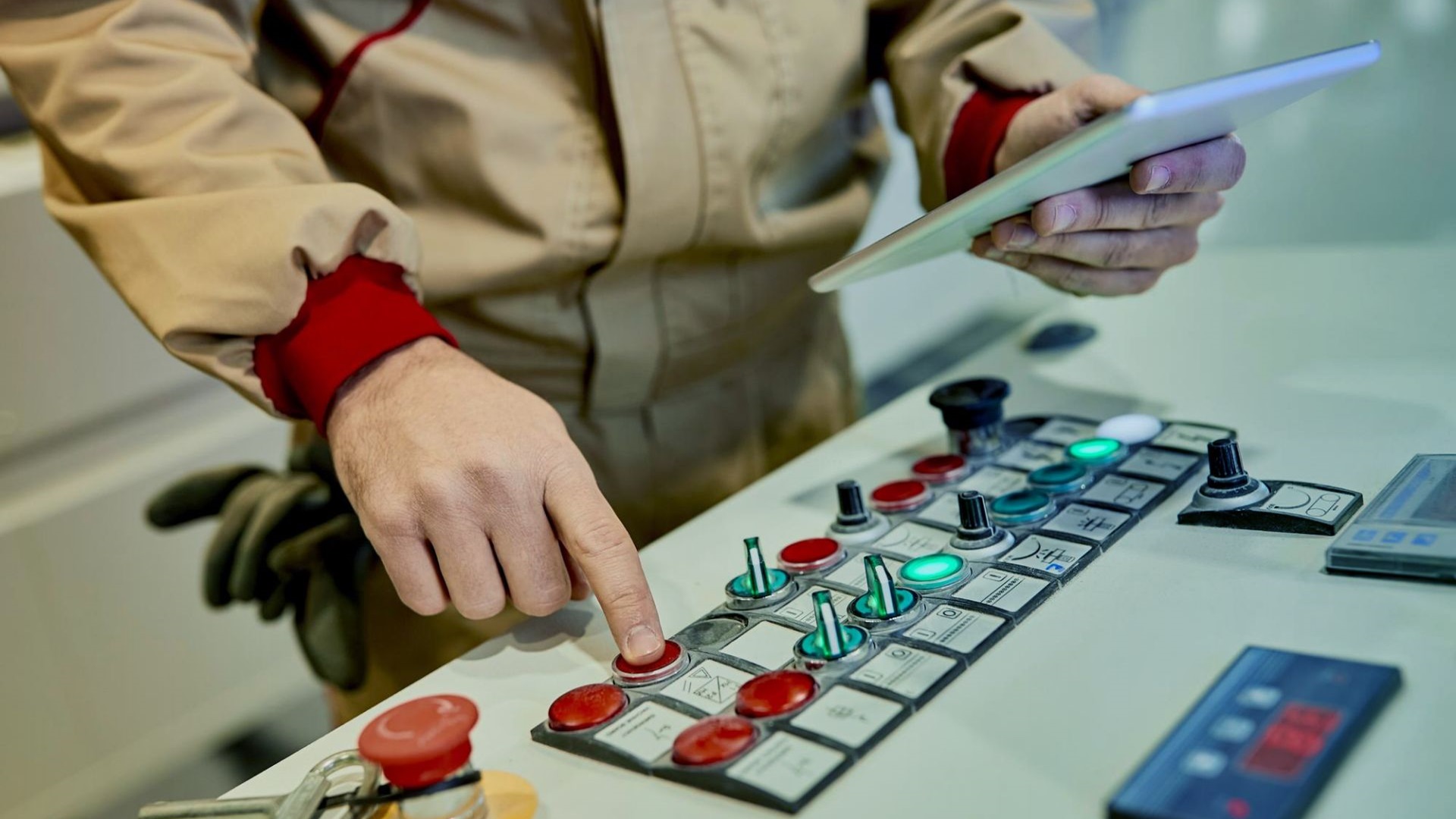
In SCADA projects, thousands—sometimes even hundreds of thousands—of data points flow every second.
Temperature, pressure, motor current, meter values… All of them are continuously generated together with timestamps.
If such high-volume time series data is not collected with the right database architecture, the system first slows down, and then maintenance and reporting become a serious operational burden.
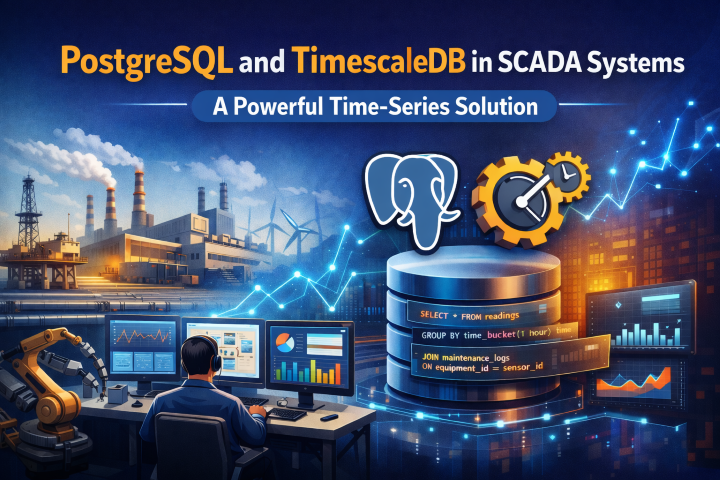
This article was prepared to clearly explain why the TimescaleDB extension is the right choice for SCADA projects that use PostgreSQL.
We will go into technical details, but keep the language simple. The goal is to enable both OT and IT teams to read this text together and say, “This is the right solution for our architecture.”
Why Time Series Databases Are a Separate Topic in SCADA Systems
Most of the data stored on the SCADA side is structurally simple:
-
Timestamp
-
Measurement value
-
Tag name (or device/signal identifier)
However, the volume is extraordinarily large.
Example signals include:
-
Temperature sensors
-
Pressure transmitters
-
Energy analyzers (current, voltage, power)
-
Production line speeds, counters
Let’s assume that thousands of tags generate records every second.
In a very short time, millions of rows are created.
How Far Can You Go with Plain PostgreSQL?
Many SCADA systems still use plain PostgreSQL or similar relational databases. This is possible and works smoothly up to a certain scale. However, as data grows, typical problems emerge:
-
Increased disk I/O due to continuous insert load
-
Rapid growth of timestamp indexes
-
Slow queries over long time ranges
-
Manual and risky archiving of old data
The problem is not that PostgreSQL is weak; the issue is that the time series data pattern is fundamentally different.
SCADA data:
-
Is written very fast
-
Is read frequently (trends, charts, alarms)
-
Is almost never updated
-
Is expected to be stored for years
This pattern requires an additional optimization layer. This is exactly where TimescaleDB comes into play.
What Is TimescaleDB? What Does It Add to PostgreSQL?
TimescaleDB is a time series extension that runs on PostgreSQL.
You do not learn a new database; you enhance PostgreSQL for time series workloads.
The core distinction is:
-
PostgreSQL → General-purpose relational database
-
TimescaleDB → Optimizes PostgreSQL for time series data
From a SCADA perspective, this is critical because:
-
The existing PostgreSQL infrastructure remains unchanged
-
SQL knowledge remains fully valid
-
Time series data and relational data live in the same database
Hypertable Logic: How SCADA Data Scales
At the heart of TimescaleDB lies the hypertable concept.
A hypertable:
-
Appears logically as a single table
-
Is physically partitioned into time-based chunks
What does this provide?
-
Tables do not “bloat” even after years of data accumulation
-
Queries read only the chunks relevant to the requested time range
-
Old data can be compressed while recent data remains fast
In SCADA terms, this means:
-
Last 1-hour trends are very fast
-
Last 1-year reports have consistent performance
-
5–10 years of archives remain manageable
Critical SCADA Requirements and Their TimescaleDB Counterparts
Let’s clearly map typical SCADA requirements to what TimescaleDB offers:
High write throughput
→ Time-series-optimized insert paths and chunk architecture
Fast trend and chart queries
→ Time-based indexing and chunk pruning
Long-term data retention (years)
→ Automatic compression and efficient storage of old data
Alarms, KPIs, and energy analysis
→ Full SQL support, window functions, joins
High availability and backup
→ Mature PostgreSQL ecosystem for HA, replication, and backups
Write Performance: Can It Handle SCADA Load?
Consider a typical SCADA scenario:
-
20,000–50,000 tags
-
Most sampled every 1 second
-
Some sampled every 100 ms
When properly configured, TimescaleDB can comfortably handle this load:
-
Correct chunk duration (e.g., daily or hourly)
-
Batch inserts
-
Proper indexing
In practice:
-
Tens of thousands of inserts per second are achievable in a stable manner
-
This is more than sufficient for the vast majority of SCADA projects
The key point here is sustainability rather than raw performance.
TimescaleDB maintains consistent performance over years.
Query Performance: Trends, Reports, or Analytics?
SCADA queries can generally be grouped into three categories:
-
Operator trends (last minutes / hours)
-
Engineering reports (daily / monthly)
-
Long-term analytics (year-based)
TimescaleDB is strong in all three:
-
Time-based aggregation with
time_bucket() -
Integration with asset, maintenance, and production tables via joins
-
Advanced analytics using window functions
Examples include:
-
“Energy consumption of machines maintained over the last 2 years”
-
“Shift-based production efficiency”
-
“Sensor behavior analysis before failures”
All of these can be implemented with a single SQL query.
Long-Term Data Retention and Regulatory Advantages
In sectors such as energy, water, natural gas, food, and pharmaceuticals:
-
Data must be retained for 3–5 years or longer
-
Historical data is required during audits
TimescaleDB provides significant advantages here:
-
Automatic compression of old data
-
Managing hot and cold data within the same table
-
Backup and restore processes aligned with enterprise standards
This reduces legal and operational risks in SCADA projects.
SQL Advantage: Team Skills and Development Speed
TimescaleDB’s greatest strength is simple:
You do not learn a new language.
-
Anyone who knows SQL can be productive
-
BI tools (Power BI, Grafana, Tableau, etc.) connect directly
-
IT teams are already familiar with PostgreSQL administration
This results in:
-
Lower training costs
-
Faster development cycles
-
Fewer operational surprises
When Is PostgreSQL + TimescaleDB the Right Choice for SCADA?
TimescaleDB is a very strong option in the following scenarios:
-
Long-term data retention (3–10 years) is required
-
SCADA data must be analyzed together with maintenance, fault, and production data
-
A large SQL-proficient IT team is available
-
Auditing, reporting, and traceability are critical
-
PostgreSQL infrastructure is already in use
Conclusion: A Logical Evolution for PostgreSQL-Based SCADA Systems
For SCADA projects that use PostgreSQL, TimescaleDB represents:
-
Not a radical change
-
But a logical and controlled evolution
You gain time series performance, while:
-
Keeping SQL
-
Preserving enterprise infrastructure
-
Preparing for long-term growth
The most correct approach is this:
Build an architecture that handles today’s load while effortlessly supporting tomorrow’s growth.
PostgreSQL + TimescaleDB is one of the solutions that best achieves this balance in the SCADA world.