
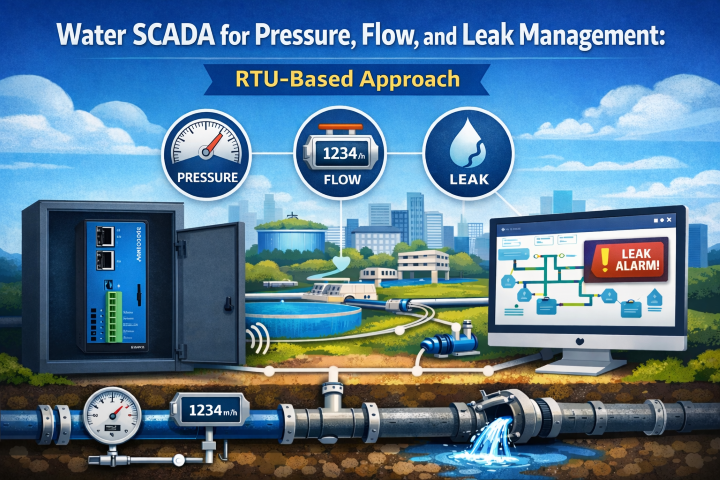
Imagine a water network as an invisible city. Its streets are pipes, its traffic is water, and its traffic lights are valves and pumps. In this city, problems rarely come alone; pressure, flow, and leakage are often three different sentences of the same story. When pressure rises too high, leakage increases; as leakage grows, flow behavior changes; when flow changes, pump control becomes unstable.
For this reason, when designing a Water Distribution SCADA system, these three topics must be managed together rather than separately. No matter how good the central screens are, decisions are only as accurate as the measurements coming from the field. For example, if a pressure sensor constantly saturates because its measurement range is selected incorrectly, the system may say “everything is normal” or “critical alarm”—and both conclusions would be wrong.
In this article, from an RTU-focused perspective, you will see step by step how to build a more robust structure for DMA monitoring, telemetry quality, leakage detection methods, and pump control logic. If you want to refresh the general framework of SCADA, “What is SCADA and how does it work?” is a good starting point.
Telemetry Fundamentals with RTUs: Correct Measurement, Correct Alarm, Correct Decision
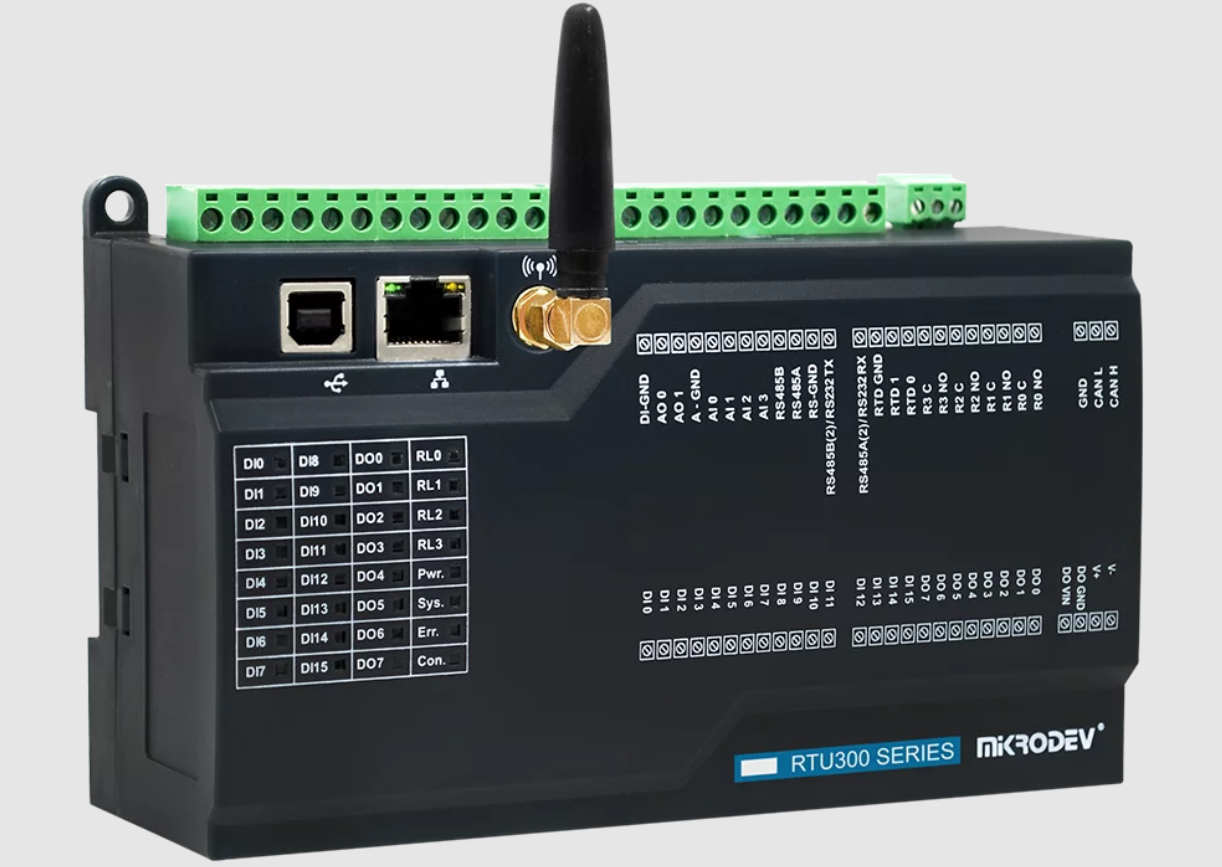
In Water Distribution SCADA systems, the RTU acts as the “eyes and ears” in the field. It receives signals from sensors, converts them into meaningful data, adds timestamps, makes local decisions when required, and sends the information to the center. The smallest weakness in this chain can create a domino effect in sensitive tasks such as leakage detection.
The role of the RTU in the field is not limited to transmitting data. In a well-designed telemetry architecture, the RTU also handles:
-
Signal validation (out-of-range, disconnected, frozen values)
-
Local alarm generation (high pressure, no flow, meter fault)
-
Data buffering during communication outages and forwarding afterward
-
Simple control logic (pump start/stop, setpoint tracking)
Several critical factors determine telemetry quality. These are often overlooked after “installation is complete,” yet they are what actually govern the network.
-
Sensor quality and correct selection: A pressure transmitter may be of the right class, but if the range is wrong, the data becomes unusable. A flowmeter may be the right type, but if installation conditions are not met, the system reads the flow incorrectly.
-
Installation and hydraulic conditions: If the pressure measurement point is too close to a pump discharge, where pressure surges occur, the sensor reads oscillations. If flow is measured after elbows or valves that create turbulence, values fluctuate.
-
Sampling and filtering: A one-second RTU reading is not the same as a 15-minute average. Different strategies are required to capture pressure transients versus night minimum flow.
-
Time synchronization: Pressure drops and flow increases must be seen simultaneously. If clocks drift, correlation breaks down. Event sequences appear incorrect on the SCADA screen, leading teams to investigate the wrong location.
-
Communication reliability: Packet loss, latency, and dropouts do not just mean “data missing.” They mean missed alarms, fragmented trends, and inaccurate reports.
Critical Field Considerations for Pressure and Flow Measurement
(Sensor selection, installation, calibration)
Correct measurement in the field is often achieved through decisions that seem “small” but have major impact:
-
Pressure transmitter range: If normal operation is around 4 bar, a 0–16 bar sensor is often a better choice. Selecting 0–100 bar reduces resolution and hides small but important changes.
-
Surges and vibration: If pressure spikes during pump starts, move the measurement point slightly away from the pump. Use mechanical dampers if necessary.
-
Calibration routine: “Installed and running” is not enough. Perform field verification, especially since alarm thresholds depend on it.
-
Flowmeter types (briefly): Electromagnetic meters are common for conductive liquids; ultrasonic measurement can be practical in some pipelines. Selection depends on pipe material, diameter, conductivity, and maintenance conditions.
-
Straight pipe requirements: Measuring flow immediately after an elbow is like weighing something in the wind. Leave straight pipe lengths at the inlet and outlet as recommended by the manufacturer.
-
Filtering: Excessive filtering at the RTU prevents capturing transients; no filtering causes alarm flooding. Balance must be found in practice.
A short example of how faulty measurement disrupts the system: suppose the DMA inlet flow sensor reads 10% high due to turbulence. Night minimum flow reports appear constantly high. The team plans excavations for a “leak,” while the real issue is measurement error. The opposite can also occur: a real leak exists, but the sensor reads low, delaying detection.
RTU Data Management: Sampling Rate, Event-Based Recording, Buffering During Communication Loss
Not all data should be read at the same rate. Pressure can change within seconds, while flow usually changes more smoothly. Decisions about “how each variable is recorded” on the RTU are as important as leakage detection and pump control.
-
Sampling rate: To observe pressure transients, second-level (or faster) sampling may be required. For night minimum flow, minute-level sampling is often sufficient. The goal is to see the right picture without generating unnecessary data.
-
Event-based recording: Instead of logging every second, increasing the recording frequency when a threshold is exceeded is highly effective. For example, if pressure changes rapidly within 0.5 bar, the RTU can switch to a “dense logging” mode, then return to normal.
-
Store and forward (buffering): Communication interruptions are normal in water networks. The RTU should store data locally during outages and forward it sequentially once the connection is restored. This prevents gaps in trends and improves alarm analysis.
-
Data integrity and time synchronization: The RTU clock must be regularly synchronized (via NTP or GPS). If timestamps are incorrect, the sequence of “did pressure drop first or did flow increase first?” becomes unreliable.
-
Alarm thresholds: Using two levels—such as “warning” and “critical”—is often more effective than a single threshold. Different thresholds may also be needed for day and night behavior.
How Leakage Detection Is Performed Using Pressure and Flow with DMA
DMA (District Metered Area) divides the network into measurable zones. Simply put, each zone has a known inlet and its consumption can be monitored. This turns leakage detection from “searching for a needle in the whole city” into “searching neighborhood by neighborhood.”
When DMA is implemented, two things change in the Water SCADA system:
-
Data is no longer viewed as one large pipeline but as regional behavior.
-
Telemetry from RTUs directly turns into operational plans (night crews, valve maneuvers, pressure reduction, pump scheduling).
The most understandable leakage detection methods usually fall into three categories:
-
Night minimum flow (MNF): Monitoring inlet flow during hours of lowest consumption.
-
Pressure profile: Tracking pressure drops and unexpected fluctuations.
-
Inlet-outlet balance: Comparing DMA inlet measurement with the sum of downstream meters.
Each method works individually, but together they become much more reliable. Leakage does not always produce a single signal. Sometimes flow increases without a pressure drop; sometimes pressure drops while the flow sensor lags.
Generating Leakage Suspicion with Night Minimum Flow and Pressure Profiles
The night minimum flow approach is practical and fast, but incorrect implementation leads to false positives. A workable field approach may look like this:
-
Select the time window: Choose a period such as 02:00–04:00 based on zone characteristics. Not all DMAs require the same hours.
-
Define “normal days”: Exclude holidays, events, tourism peaks, or sudden weather changes.
-
Set thresholds: Use a “normal band” instead of a single value. For example, create a band based on the median and deviation of the last 14 days.
-
Verify with pressure: If flow increases while pressure also shows unexpected behavior, suspicion grows. If pressure is stable but flow rises, night consumption may be the cause.
-
Reduce false positives: Fire line usage, agricultural irrigation, bulk consumer filling, or valve operations can distort MNF.
RTU event logs are extremely valuable here. If the operator can note “valve maneuver at 03:12,” the next day’s trend analysis becomes meaningful. The situation shifts from “data without a story” to actionable insight.
Zone Balance Control: Meters, Inlet Measurement, and Anomaly Alarms
Balance control compares DMA inlet flow with the sum of measurable consumption inside the zone. A simple example: 50 m³/h enters the DMA, downstream meters total 40 m³/h. The remaining 10 m³/h is tracked as loss (leakage, meter error, reading delay).
Two common issues arise:
-
Data latency: Some meters report periodically rather than instantaneously. Without time alignment in SCADA, the difference appears larger than it really is.
-
Meter errors and maintenance: A meter reading low may be interpreted as leakage. Alarm design should therefore be two-level:
-
Warning: Balance deviation remains outside the band for a defined duration.
-
Critical: Deviation grows and is supported by pressure profile anomalies.
-
Escalation should be simple: SCADA alarm goes to the zone owner, RTU event logs are checked, quick field verification is done (valve positions, inlet measurement, pressure points), and then a work order is issued to the leakage team.
Reducing Losses with RTU-Based Pump Control and Pressure Management
The relationship between pressure management and leakage is clear: as pressure increases, even small leaks release more water. It is similar to a punctured balloon—the higher the internal pressure, the greater the leakage.
Therefore, pump control is not just about “filling the reservoir.” The correct strategy is to maintain sufficient pressure according to demand without unnecessary elevation. RTUs provide two advantages here:
-
They can react quickly at the local level while still being connected to the center.
-
They can switch to safe operating modes even during communication failures.
Energy consumption is naturally part of this equation. Keeping pressure constantly high both increases leakage and inflates energy costs. Good setpoint management provides benefits on both fronts.
Setpoints, PID, and Stepwise Control: A Practical Approach to Stable Field Pressure
PID may sound complex, but its field objective is simple: bring pressure close to the target value and keep it stable. Without diving into mathematics, it is enough to know that overly aggressive tuning causes oscillation, while overly soft tuning responds too slowly.
Common field issues and practical solutions include:
-
Oscillation (hunting): Pump speeds up, pressure overshoots, then drops, then speeds up again. Solution: soften PID tuning and reduce noise in pressure measurement.
-
Excessive start/stop: If the pump cycles frequently, implement minimum run time and minimum stop time rules.
-
Single-sensor dependency: If control relies on one pressure sensor, failure blinds the system. Consider sensor redundancy where possible.
-
Limits: Define minimum and maximum pressure limits in the RTU. Even if a setpoint is entered incorrectly, the system remains within safe bounds.
Stepwise control is also effective. For example, lower pressure setpoints at night and slightly higher ones during daytime. These are adjusted based on DMA behavior and refined using leakage detection results.
Outage and Fault Scenarios: RTU Local Mode, Safe Operation, and Alarm Management
What should the pump do when communication is lost? The answer must be defined from the start. Good design is built on the principle that the RTU should “operate correctly even without the center.”
A basic RTU local-mode approach:
-
Continue using the last valid setpoint.
-
Enter automatic protection if critical limits are exceeded.
-
Transmit all events and data to the center once communication is restored.
Typical critical alarms include high pressure, low suction pressure, dry running, no flow (pump running but no flow), and excessive motor current. The goal of alarm management is not to generate many alarms, but to generate the right ones.
A short operator checklist is often effective:
-
Is the pressure trend aligned with the setpoint?
-
Is there flow while the pump is running?
-
Are valve positions as expected?
-
How long has the communication outage lasted?
-
Is there overlap with leakage alarms in the same DMA?
An RTU-focused approach provides three clear benefits in Water Network SCADA systems: more reliable telemetry, faster leakage detection, and more balanced pump control. If pressure and flow data are incorrect, DMA alarms and control logic will also be misguided. Accurate data shortens field time and makes interventions more targeted.
As a first step, do the following: select a pilot zone, clearly define the DMA boundaries, verify pressure and flow sensors in the field, and then gradually fine-tune alarm thresholds. Within a few weeks, the difference between “noise” and “signal” becomes clear. That is the most valuable gain for your network: making decisions based on measurement rather than guesswork.