

IEC 61131-3 Programming and Its Relation to the PLC Devices
IEC 61131-3 Programming is a coding language used for programming standards for PLC devices. In this programming, there are function blocks compiled through objects and they are integrated. IEC 61131-3 is a programming standard that can be easily learned by robotics, automation, and control technology professionals. The standard consists of function blocks used for design, testing, debugging, and support services.
IEC 61131-3 Programming can be used not only for simple programming but also for complex programming. In this way, the relationships between function blocks can be programmed more quickly and easily. This standard aims to make systems run faster, safer, and more efficiently.
IEC 61131-3 & PLC
PLC devices are designed using IEC 61131-3 Programming standards. These programming standards are productive and robust programming languages used for control systems consisting of mechanical, electrical, hydraulic, and automation technologies that are frequently updated. IEC 61131-3 Programming standards allow for device evolution and updates. These standards are envisioned to be used in commercial environments that change over time, to create working environments flexibly and efficiently. The advantages of PLC devices can be increased with IEC 61131-3 Programming.
The most important feature is that PLC devices allow programming used in complex systems that can be programmed in large numbers. Furthermore, the devices show the ability to withstand exposure to extreme conditions with limited loss of performance.
IEC 61131-3 Programming is also defined as the programming language used to update the instantaneous status of various control systems and to control various sensors and environmental factors. These standards are also used to enable the system to operate more efficiently in environments that are not exposed to advanced conditions. For example, security control systems use this programming to monitor and control environmental factors such as airflow control systems.
Keeping in mind all of these, IEC 61131-3 Programming can be used in many PLC devices. As mentioned above, this type of programming is used to control the existing system more efficiently and accurately. In addition, the programming code contains important information about the structure of the devices being programmed; it can also be used to monitor the status of the devices. This increases the productivity and control of the PLC device.
Technical Details of IEC 61131-3 Programming
IEC 61131-3 specifies the syntax and meaning of a unified suite of programming languages for programmable controllers (PLCs). This set includes two written expressions of meaning, the instruction list (IL) and structured text (ST), as well as two visual expressions, the ladder diagram (LD) and the function block diagram (FBD).
PLCs are computers used in industrial automation to control input and output signals. PLCs are used in different industries, for example in manufacturing, packaging, logistics, and energy.
IEC 61131-3 programming is a standard programming method used for PLCs. This standard facilitates the development and portability of PLC programs.
IEC 61131-3 programming is used in PLC devices for the following purposes:
- Control input and output signals
- Making calculations
- Create schedules and sequences
- Checking for errors
IEC 61131-3 programming can be done with five programming languages used in PLC devices:
- Instruction List (IL): This language has a structure similar to machine language. IL is the oldest and most widely used language in PLC programming.
- Structured Text (ST): This language has a similar structure to high-level programming languages such as C and Pascal. ST is an increasingly popular language in PLC programming.
- Ladder Diagram (LD): This language has a structure similar to electrical circuits. LD is a language widely used by electrical engineers in PLC programming.
- Function Block Diagram (FBD): This language has a structure consisting of function blocks. FBD is a language used to easily create complex PLC programs.
- Sequential Function Chart (SFC): This language has a step-by-step structure. SFC is a language used to visualize complex PLC programs and make them easier to understand.
IEC 61131-3 programming is the most common method used to program PLC devices. This standard has facilitated the development and portability of PLC programs, making PLCs widely used in industrial automation.
Microdev PLC Products with IEC 61131-3 Programming Integrated
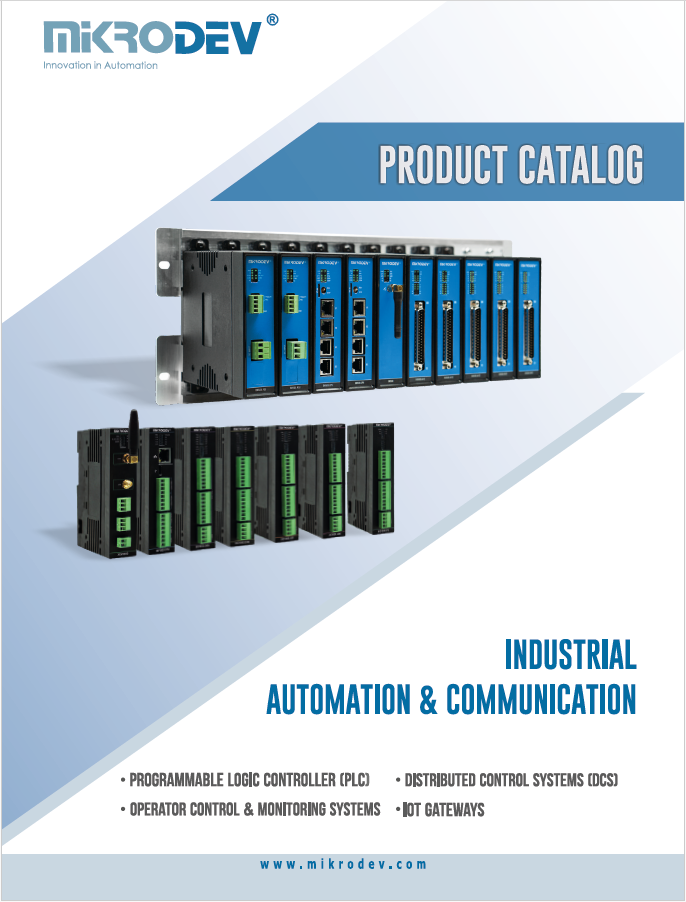
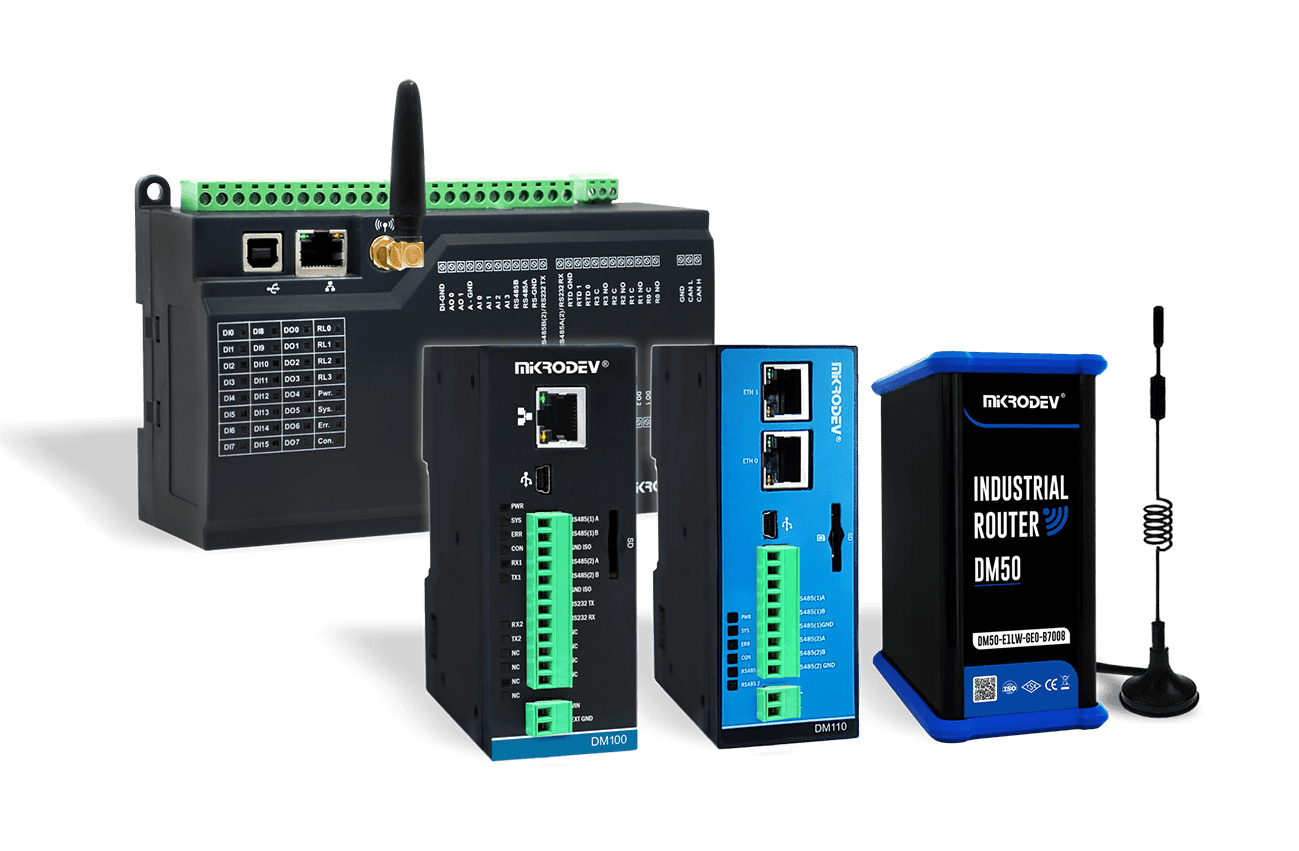
IEC 61131-3, an international standard for programming languages in the field of industrial automation, is mostly supported in Mikrodev’s PLC products. PLC devices in Mikrodev’s product range can be programmed using several programming languages that support the IEC 61131-3 standard. This standard defines the syntax and meanings for programming PLCs as well as the rules for creating and managing programs. In terms of the IEC 61131-3 standard, which allows users to program PLCs using different programming languages, Mikrodev is one of the few companies in the world that has an IEC 61131-3 compliant library of its own design. You can find Milkrodev PLC devices and products with IEC 61131-3 standard in the product list below, and if you wish, you can list these products according to different features by using the filtering feature of our related PLC product category page:
- MP110-E1N-GB0-B6000
- MP211-E1N-GA1-B6001
- MP110-E1G-GB0-B6000
- MP110-E1L-GB0-B6000
- MP110-E1L-GB1-B6000
- MP110-E1N-GB1-B6000
- MP110-E1G-GB1-B6000
- MP211-E1G-GA1-B6001
- MP211-E1L-GA1-B6001
- MP211-E1W-GA1-B6001
- MP211-E1G-GA1-B7001
- MP211-E1L-GA1-B7001
- MP211-E1N-GA1-B7001
- MP211-E1W-GA1-B7001
- MP211-E1N-GA0-B6001
- MP211-E1G-GA0-B6001
- MP211-E1L-GA0-B6001
- MP211-E1W-GA0-B6001
- MP211-E1G-GA0-B7001
- MP211-E1W-GA0-B7001
- MP211-E1L-GA0-B7001
- MP211-E1N-GA0-B7001
- MP211-E1N-GA3-B6001
- MP211-E1N-GA4-B6001
- MP211-E1N-GA4-B7001
- MP211-E1G-GA4-B6001
- MP211-E1L-GA4-B6001
- MP211-E1W-GA4-B6001
- MP211-E1G-GA4-B7001
- MP211-E1L-GA4-B7001
- MP211-E1W-GA4-B7001
- MP211-E1G-GA3-B6001
- MP211-E1G-GA3-B7001
- MP211-E1L-GA3-B6001
- MP211-E1L-GA3-B7001
- MP211-E1W-GA3-B7001
- MP211-E1W-GA3-B6001
- MP211-E1N-GA3-B7001
- MP211-E1G-GA6-B6000
- MP211-E1G-GA6-B7000
- MP211-E1L-GA6-B6000
- MP211-E1L-GA6-B7000
- MP211-E1W-GA6-B6000
- MP211-E1W-GA6-B7000
- MP211-E1N-GA6-B6000
- MP211-E1N-GA6-B7000
- MP211-E1G-GA7-B6000
- MP211-E1G-GA7-B7000
- MP211-E1L-GA7-B6000
- MP211-E1L-GA7-B7000
- MP211-E1W-GA7-B6000
- MP211-E1W-GA7-B7000
- MP211-E1N-GA7-B6000
- MP211-E1N-GA7-B7000