
Urban lighting is a budget item that quietly grows within municipalities. Thousands of luminaires, panels, cables, maintenance teams, fault reports… And the problem doesn’t end with the electricity bill. A dark street immediately affects public safety perception. Being unable to quickly answer questions like “Where is the fault?”, “Which line is still on during the day?”, “Which area has increased consumption?” means both financial and reputational loss.
This is where lighting automation comes into play. Smart luminaires and sensors collect data from the field, and centralized software turns this data into meaningful information. SCADA, used for city-scale control, establishes a systematic structure for monitoring the field on a single screen and sending remote commands.
In this article, you will clearly see how smart lighting works across the city, what SCADA adds to operations, and how optimization is established for measurable energy savings.
How Does City-Scale Smart Lighting Automation Work?
Managing city-wide lighting is not like managing a building. In a building, you operate within the same electrical infrastructure and relatively similar conditions. In a city, every street has its own story: different cabinet conditions, different line loads, different communication quality, and different security risks.
At a high level, the architecture consists of three layers. The first layer is the field: luminaires, drivers, panels, meters, sensors, and controllers that connect them. The second layer is communication: data is securely and sustainably transferred from the field to the center. The third layer is central software: SCADA and related applications integrate map-based monitoring, alarm management, reporting, and control.
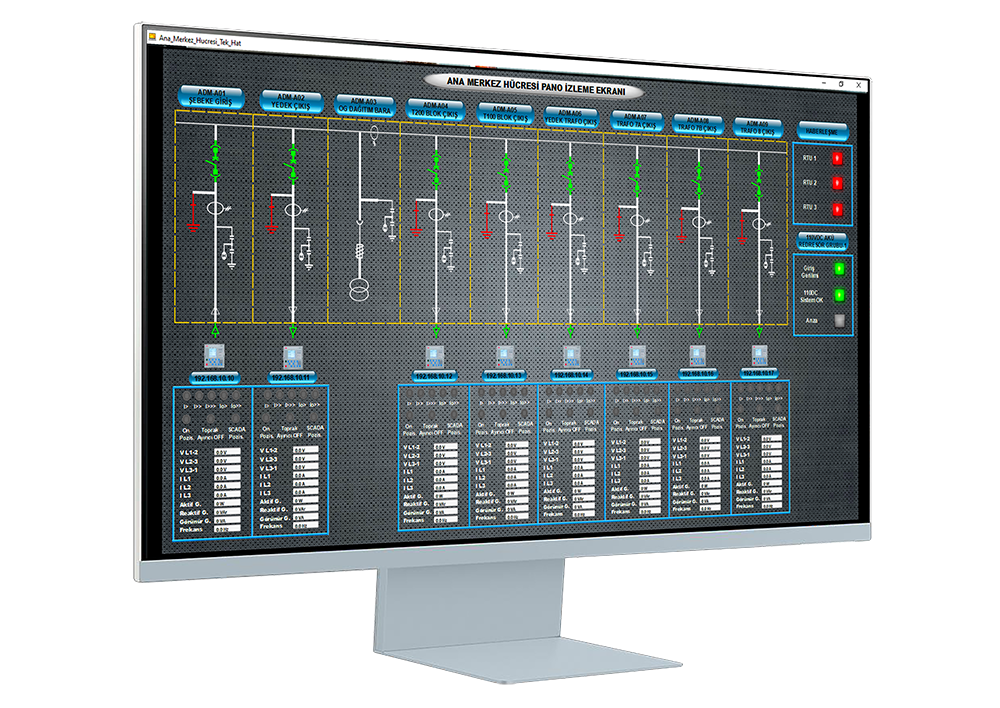
Think of SCADA simply as a “live dashboard” that displays lighting assets across the city in a single control room. Operators can see faults, review history, and send commands when necessary. Its value in smart city approaches is not limited to turning lights on and off. When integrated with traffic systems, security cameras, environmental sensors, and energy monitoring, the city begins to “speak the same language.”
This integration is critical in smart city projects, because data from one system affects decisions in another. For example, increasing lighting on busy routes, activating event-day scenarios, or adjusting light levels during adverse weather conditions is only possible through holistic control.
Field Components: Luminaire, Driver, Meter, Sensor, and Controller
The only “smart” component in the field is not the luminaire. The system is like an orchestra: if every instrument plays correctly, the city is illuminated efficiently and energy is not wasted.
LED luminaires have become standard. Their main advantage is easy dimming. The driver inside or next to the luminaire manages power delivery and adjusts output based on dimming levels.
Two sensors are particularly useful: motion sensors and ambient light sensors. Motion-based lighting reduces unnecessary consumption at night. Ambient light sensors provide consistent control during sunrise and sunset. Additionally, cabinet door status, temperature, and humidity data are valuable for operations.
Energy meters and analyzers turn consumption from “estimation” into measurable data. Common SCADA data includes on/off status, dim level, current, voltage, power, kWh, luminaire temperature, driver faults, and power outage alerts. When collected properly, maintenance teams go to sites with diagnostics, not guesses.
How Data Reaches the Center: Network Options and Field Realities
Communication is the bridge that gives field data meaning. A broken bridge renders even the best sensors useless.
Common city-scale options include fiber, cellular (2G/4G/5G), RF mesh, and LoRaWAN. Fiber offers high bandwidth but high installation cost. Cellular networks are quick to deploy but require SIM management. RF mesh creates coverage between poles but needs careful planning. LoRaWAN is suitable for low-data scenarios but requires careful design for frequent control.
Field realities shape projects. Coverage maps may look good on paper, but signals weaken inside cabinets. Power outages affect communication devices. High summer temperatures require proper hardware and ventilation. Hybrid approaches are often the most realistic.
What Does Remote Monitoring and Control with SCADA Provide?
Visiting thousands of points individually is one of the most expensive habits in city operations. SCADA breaks this habit by enabling screen-based management.
Map-based monitoring is the most visible benefit. Poles, panels, substations, and zones appear with status information. SCADA also keeps event logs, answering questions such as when a luminaire was turned off or who changed a profile.
Authorization is essential. Role-based access, logging, and backups prevent operational risks.
Maintenance workflows change as well. Instead of “let’s check the complaint,” teams depart with alarm groups, root causes, and affected areas. This increases first-time fix rates and supports preventive maintenance.
Alarm and Fault Management: Accelerating Resolution
Poorly designed alarm screens overwhelm operators. Good design transforms alarms into actionable information.
For example, instead of showing 20 separate alarms for voltage drops, SCADA groups them into a single root alarm. Thresholds and verification rules reduce false alarms, improving quality.
Scheduling and Dimming Scenarios: Zone-Based Management
Time scheduling is essential. Fixed schedules cause unnecessary operation. SCADA enables automatic seasonal scheduling.
Dimming scenarios balance safety and savings. Main roads may run at 100% in the evening and 70% at night. Parks can operate at 40% and rise to 90% when motion is detected. Event profiles can be applied temporarily.
Management is done by zones and profiles, not individual luminaires. Standardization reduces errors.
Optimization for Energy Savings: Measure, Compare, Improve
Energy optimization is a continuous cycle: measurement, target setting, action, and verification.
Key data sources are panel meters and luminaire telemetry. Targets may include monthly kWh reduction, fault duration, and maintenance visits.
Common KPIs
| KPI | Meaning | Improvement Area |
| Total consumption (kWh) | City lighting load | Budget planning |
| kWh per luminaire | Efficiency comparison | Dimming profiles |
| Fault duration (hours) | Service impact | Response planning |
| Maintenance visits | Field cost | Preventive maintenance |
Verification follows M&V principles using baseline comparisons.
Establishing Baselines and Proving Savings
A baseline answers: “How much do we normally consume?” kWh data is essential. Calculations based only on power ratings miss real losses and usage patterns.
Panel meters and luminaire telemetry together provide reliable baselines. Factors like day length, weather, and usage density must be considered.
Detecting Loss and Waste
Savings come from optimization and loss prevention.
Examples:
- Daytime lighting detected automatically
- Continuous 100% dim indicates profile issues
- Unexpected consumption signals leakage or faults
- Low power factor causes penalties
Optimization reports should include both energy and operational savings.
Implementation Plan: Pilot, Expansion, Sustainability
City-scale transformation works best through pilots. A pilot area is selected, inventory created, targets defined, and training planned.
Inventory is critical: locations, connections, meters, and communication quality must be known. Data ownership and SLA terms must be defined.
Standard device profiles and naming conventions reduce compatibility risks.
Choosing the Right Pilot Area
The best pilot represents the city on a small scale.
Technical criteria: traffic density, luminaire variety, coverage, panel diversity.
Social criteria: complaint frequency, safety needs.
Success metrics must be defined early.
Cybersecurity and Continuity
Remote control brings responsibility. A single misconfiguration can affect large areas.
Best practices:
- Network segmentation
- Strong authentication
- Clear authorization matrix
- Update and backup plans
- Disaster recovery testing
Proper logging is essential for security and operations.
Managing urban lighting is more than turning lamps on. Remote monitoring makes field activities visible, and SCADA enables centralized control. Automation standardizes scheduling and dimming. Measurement and verification turn savings into reportable results.
Next step: clarify your inventory and select a pilot area. The pilot tests both technical design and operational models. Then, expansion proceeds with fewer surprises. With accurate data and proper control, your city’s lighting becomes truly manageable.